
 |
|
 |
1969 Corvette Specifications
C3
|
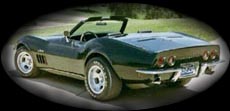
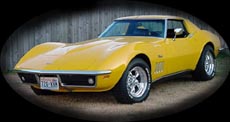
The Stingray name (now spelled as one word) appears on the front fenders above four vertical fender vents. The backup lights were integrated into the center tail lights. The fenders are unflared and the front cornering lamps are round. The steering-wheel diameter was trimmed an inch for more under-rim thigh clearance. Interior door handles and control knobs were redesigned. A warning light was added to warn that the headlights hadn't completely opened. The ignition is now on the steering column and the door depression button used in 1968 was eliminated. A key lock was put in it's place. The interior has glove box mounted map pockets but no wood on the door panels. Front and rear disc brakes, headlight washers, center console, wheel trim rings, carpeting and all vinyl upholstery are standard; the windshield-washer jets were moved to the wiper arms. The frame was stiffened and standard rim width went up to eight inches. An attempt was also made to improve the Astro Ventilation flow volume, but the results were far from satisfactory. In 1969 there were 116 cars built with the L88 engine option. These cars were all to be racers, so they did not have heaters or radios, and most came with transistor ignition, special heavy duty brakes, special front and rear suspension and heavy duty close ration 4 speed transmission. The horsepower was 430 hp when it should really have been 560 hp. The 1969 Corvette build cycle was from September 1968 until December 1969. Serial Numbers: 194379S700001 through 194379S738762 -- For Convertibles, the fourth digit is a "6" Fisher Body Style Number 69-19437 identifies a Corvette Stingray coupe Early or Late, that is the question! The early/late changeover was at approximately SN#18,744 in March 1969. A good rule of thumb is to check the vacuum actuator located on the right side of the firewall. The actuator was changed from the "can" shape on the early 69s to the "double pie plates" shape on the late 69s. This is not always accurate because some of the late 69s have the "can." Many of the parts changed during production, and early and late does not necessarily have anything to do with when the car was built. Even worse, some of the very early 69s used parts leftover from the 68 run, and some of the late 69s have parts that were supposed to be on the 70s. Vehicle Identification Number (VIN) Number Break Down
1st Digit is the Division: 1 = Chevrolet The serial number (VIN) is stamped on a plate on the inner vertical surface of the left windshield pillar visible through the windshield. The trim tag is located on the driver's hinge post. It has the codes for the original exterior paint and interior trim colors and the time/build date for your car. See chart for build date following Basic Specifictions. The engine ID and engine VIN are stamped on a casting boss on the front right hand side of the engine block. The engine VIN is a nine character number normally found beside or under the engine ID code. The engine VIN is stamped onto the boss by the final assembly plant (where the car is actually built). The number contains a divisional code (1 = Chevrolet), the last digit of the vehicle model year, and a 1 character letter code for the vehicle assembly plant ( S = St. Louis). Following the three characters are the last six digits of the vehicle serial number. The last six digits should match the last six digits of the car's VIN. If the numbers do not match, the engine is not original. In 1969 Corvette small block engines were built in Flint and prefixed with a source designation of "V." All the big blocks were built at Tonawanda and prefixed with a source designation of "T." The T or V is followed by four digits representing the date of manufacture. The first two digits representing the month ("01" through "12" ), the last two digits representing the date of the month ("01 through "31") and they end with the engine type suffix code (see the Engine Suffix list below). In 1969 Corvette used Holley and Rochester Carburetors. The Month Letter "I" Generally the letter "I" will be used to represent the month of September only on Chevrolet Central Foundry metal castings. It is generally skipped over and not used to represent September on hand or machine die-stamped components such as alternators, distributors, carburetors, radiators, etc. The stamped letter "I" is, however, used to represent the ninth month of body production on St. Louis body identification tags. |
Total Build 38,762
|
|


|
 Top
Top
|
Engine Suffix
An example of an engine ID for 1969 might be T0101LO. The first character T would indicate that the engine was a 427 built at the Tonawanda plant. The following four digits represent the date of manufacture. The first two digits would be the month 01 (January). The next two digits, 01, would be the day of the month. The final two characters, LO, is the engine suffix a 427 ci, 430 hp, manual transmission. |
Top
* Available Non-Positraction Axel Axle codes will be stamped on the bottom of the differential carrier housing just forward of the cover. The axle type and ratio identification prefix code letters will be followed by various numbers and letters which may indicate the date of manufacture, plant, and/or type of axle. |
Top
|
Top
The body build date is located in the upper left side of the Trim Tag. See Color Options for color/interior codes. |
||||||||||||||||||||||||||
Colors / Options
|
Exterior Colors
This chart lists the original paint manufacturers stock numbers for Corvette refinishing paint. The manufactures listed are Dupont, Rinshed-Mason, and Ditzler. Corvette body paint used through 1957 was nitrocellulose lacquer. All exterior paint for 1958 and later was acrylic lacquer. It must be noted the paint numbers listed are those originally specified by Chevrolet and the paint suppliers as being as close a match as possible when the vehicles were new. Not all colors listed are available today. |
|
Interior Colors
|
|
Options
|
Top